
Factcheck.bg: Bulgaria’s Ukraine Security Deal Mirrors EU Practice, Not an Isolated Case
Politics | April 6, 2026, Monday // 12:00| views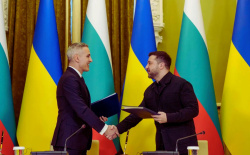
A political dispute in Bulgaria has recently centered on the bilateral security cooperation agreement with Ukraine, after criticism emerged over its signing without prior approval from the National Assembly. The document, concluded by the caretaker government, became a focal point in the election debate, with opponents arguing that parliamentary consent should have been required.
Further reading: What Bulgaria and Ukraine Actually Signed in Kyiv
A detailed review by Vasilena Dotkova from Factcheck.bg indicates that Bulgaria is not an exception in this regard. Across the European Union, similar agreements with Ukraine have generally been signed by executive authorities without being submitted for parliamentary ratification, either before or after signing. In most cases, these arrangements are treated as political commitments rather than binding international treaties.
According to the compiled data, 22 EU member states have signed bilateral security agreements with Ukraine, including Bulgaria. These were largely concluded in 2024, following an initiative first promoted by the G7 countries after Ukraine was not invited to join NATO at the Vilnius summit in 2023. The G7 then issued a declaration encouraging long-term bilateral security cooperation, later joined by dozens of other countries.
The agreements typically follow a similar structure: they are signed for a period of around ten years, express political and security support for Ukraine, and are implemented through executive decisions. Most explicitly state that they do not constitute legally binding treaties under national or international law.
Only a small number of EU states - Austria, Cyprus, Malta, Hungary, and Slovakia - have not joined the framework. Some of these countries have maintained differing political positions regarding sanctions and military support for Ukraine.
Factcheck.bg notes that in the vast majority of cases, national parliaments were not involved in approving the agreements. Governments in countries such as Germany, Belgium, Denmark, Estonia, Ireland, Spain, Italy, Latvia, Lithuania, Luxembourg, the Netherlands, Poland, Portugal, Slovenia, Finland, Croatia, the Czech Republic, and Sweden signed the documents without prior parliamentary votes.
In several cases, parliaments were only informed after signing, typically through committee briefings or government statements. Germany, for example, signed its agreement without Bundestag approval, later notifying lawmakers. In Estonia and Ireland, the agreements were presented as political declarations of intent rather than binding contracts.
Denmark, Latvia, Lithuania, and several others followed similar procedures, with governments emphasizing that the documents did not create new legal obligations. In Spain and Portugal, legal frameworks explicitly allow such agreements to be concluded by the executive without parliamentary ratification when they are non-binding in nature.
Italy and Luxembourg also classified the agreements as political in character, with no requirement for parliamentary approval. In some countries, such as France and Romania, parliamentary involvement occurred only after signing, either through debates or votes that did not affect the agreements’ validity.
Romania represents one of the few cases where parliament later voted on an attempt to annul the agreement, which ultimately failed, confirming cross-party support. France held a parliamentary discussion following signing, where a majority of deputies backed the government’s position.
In other cases, including Belgium, Greece, Sweden, and the Czech Republic, there is no evidence of parliamentary votes either before or after the agreements were concluded. Finland held only committee-level discussions shortly before signing, without a formal ratification process.
Across all reviewed cases, the agreements share common characteristics: they are concluded by the executive branch, often reference existing political commitments made under the G7 framework, and explicitly avoid classification as legally binding treaties. Most also enter into force immediately upon signature.
Analysts cited in the report emphasize that these arrangements do not function as collective defense guarantees similar to NATO’s Article 5. Instead, they are intended as long-term political commitments designed to support Ukraine’s sovereignty and defense capacity under flexible national conditions.
According to Factcheck.bg, the case of Bulgaria aligns with broader European practice, where such agreements are treated primarily as strategic political instruments rather than formal treaties requiring parliamentary ratification.
Back