
Will US Boots Hit Iranian Soil? Here's What the Next Few Months Could Look Like
World | March 18, 2026, Wednesday // 11:44| views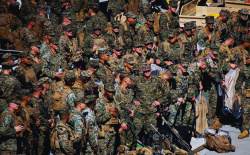
Three weeks into Operation Epic Fury, one question keeps coming up: is this going to stay an air war, or are American troops actually going to set foot inside Iran?
First, where things stand
The US and Israel launched a surprise attack on February 28, assassinating Supreme Leader Khamenei and hammering military bases, nuclear sites, and government infrastructure across Iran. The air campaign has been punishing. Hundreds of Iranian missile launchers have been rendered inoperable, around 80 percent of Iran's capacity to strike Israel has reportedly been eliminated, and the US is now flying non-stealth B-1 bombers over Iranian airspace, a move that signals near-total air dominance.
But Iran hit back. Hard. The Strait of Hormuz, the narrow chokepoint through which 20 percent of the world's oil passes, has effectively been closed, with tanker traffic dropping by around 70 percent and over 150 ships stalled. That single fact is reshaping every decision Washington is now making.
The Kharg Island problem
Prior to the March 13 raid on Kharg Island, it was reported that Israel was considering bombing the island, while the United States was actually leaning toward the idea of seizing it. That word, seizing, is what has military analysts sweating.
The idea behind a seizure is simple: capture Kharg Island, and you hold 90 percent of Iran's oil exports hostage. The problem is you have to get there first, either by sailing through a strait the US Navy currently considers too dangerous, or by flying troops onto an island sitting just 15 miles off the Iranian coast, well within range of artillery, rockets, and short-range drones Iran hasn't even deployed yet. One former US Army intelligence analyst called it, bluntly, "a potential suicide mission".
Two US officials told NBC News that Trump has privately expressed serious interest in deploying troops inside Iran, and three officials confirmed that approximately 5,000 additional Marines and sailors are being sent to the region. The troops are moving. Whether they're going in is another story.
Before the end of March? Unlikely, but not impossible
A ground incursion in the next two weeks is a low-probability scenario. The logistics alone make it nearly impossible to organize a credible amphibious or airborne operation on that timeline, especially with the Strait still effectively closed to US naval vessels. The air campaign has barely finished its second phase. Trump himself has been pushing other countries to send warships to secure the Strait of Hormuz, which suggests Washington doesn't yet have the maritime corridor needed to even attempt a landing.
That said, low probability is not zero. If Iran sinks a US warship or kills enough American service members in a single strike, the political pressure to escalate dramatically and fast becomes enormous. The Strait situation is the real wildcard. Every day it stays closed costs the global economy billions, and Trump's patience, publicly at least, is wearing thin.
Later in 2026? The math gets more complicated
If the air war drags on through spring without a ceasefire or regime collapse, pressure to do something more decisive grows. Washington's stated goals have included degrading Iran's nuclear program, ballistic missiles, navy, drones, and control of its proxy network, and the US is well on its way to achieving these objectives militarily. But military success and political resolution are two different things entirely.
Here's the logic for a later ground phase: to actually establish any lasting control over the Strait, over Kharg's oil infrastructure, over Iran's remaining enriched uranium stockpiles, you eventually need boots on the ground somewhere. Air power breaks things. It doesn't hold them.
The case for staying out
Then again, there's a strong argument the US never sends ground troops in at all, and history is the main exhibit.
Iraq 2003. Afghanistan 2001. Both started as military operations with clear objectives and enthusiastic public backing. Both became decades-long disasters that chewed through trillions of dollars, thousands of American lives, and the political capital of multiple presidencies. Iran is three times the size of Iraq. It has a population of 92 million. The terrain is brutal, the IRGC knows it, and whatever is left of the regime after these strikes will fight.
In a poll of Trump voters conducted during the June 2025 twelve-day war, 53 percent said the US should not get militarily involved in the Iran-Israel conflict. That number hasn't gotten smaller. A ground war, with flag-draped coffins coming home and fuel prices already at record levels, could be politically fatal for Trump in a way that airstrikes simply aren't.
Washington likely wants the regime to fall on its own, driven by internal protest and economic collapse. Sending in troops would actually give the regime a rallying point, a foreign invasion to unite against, exactly what it needs.
The bottom line
The US is already at war with Iran. The question now is what shape that war takes next. A ground invasion before April? Almost certainly not. A ground operation of some kind before the year is out? Possible, if the Strait stays closed, the regime refuses to collapse, and Trump decides he needs something more tangible than bomb damage assessments to call a win.
Or none of it happens, a ceasefire gets brokered, and this becomes a very expensive, very bloody chapter that ends, like Iraq and Afghanistan, without the clean resolution anyone was promised.
History suggests the last option deserves more weight than it's currently getting.
Back