
Baba Vanga: Bulgaria's Blind Mystic Who Became a Global Myth
Opinions |Author: Ivan Kolev | March 14, 2026, Saturday // 19:30| views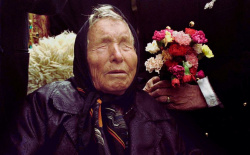
Baba Vanga @Wikipedia Commons
Ask any older Bulgarian about Baba Vanga and brace yourself. You will not get a Wikipedia summary. You will get a story. Their story, or their mother's, or their neighbor's cousin who traveled four hours on a rattling communist-era bus to reach a small town called Petrich, waited in a queue for two days, and came back home with something they could not quite explain.
That is who Baba Vanga really was, before the internet turned her into a clickbait machine.
The Guardian recently wrote about her, exploring how her name has been hijacked by propaganda and clickbait. They are not wrong. But there is more to it.
Vangeliya Pandeva Gushterova was born in 1911 in what is today North Macedonia, then still part of the Ottoman Empire. As a teenager, a tornado reportedly hurled her across a field and when she was found, her eyes were filled with sand and debris. Her family could not afford full medical treatment. She gradually went blind. What she lost in sight, the story goes, she gained in something else.
She settled in Petrich, a quiet town tucked against the Belasica mountains in southwestern Bulgaria. During World War II, people started coming to her with a simple, desperate question: is my son alive? Is my husband coming back from the front? Word spread the way it does in small communities: quietly, persistently, and with absolute conviction.
By the 1960s, the queues were no longer small. They stretched for days.
This is where things get interesting, because the Bulgarian communist government, which is officially atheist and officially hostile to mysticism, did not shut her down. They studied her. The Institute of Suggestology in Sofia sent researchers. The state put her on the payroll, gave her secretaries, and assigned a formal system for managing the flood of visitors. Academics claimed her accuracy rate was somewhere around 70-80 percent, a figure contested by skeptical scientists at the time who called the whole phenomenon a "mass psychosis." The state funded the research either way. She appeared on television. She became, quietly and officially, a state-sanctioned enigma.
People came from Romania, Greece, Russia, all across Eastern Europe. Leonid Brezhnev reportedly visited. Letters arrived by the thousands. And yet, if you ask Ivan Dramov of the Baba Vanga Foundation (the organization she herself chaired before her death in 1996), what she actually told people, the answer is strikingly ordinary. She told them which doctor to see. She told them what was wrong with their health. She spoke about personal fates, family troubles, things that mattered to the person sitting in front of her. Not world wars. Not alien invasions.
"She dealt mainly with people's health problems," Dramov has said, "not with upcoming cataclysms in the world."
But here is the thing about memory, especially collective memory wrapped in decades of longing and nostalgia. For the generation that lived through communist Bulgaria, Vanga is not a historical figure. She is personal. She is the woman who told your grandmother that the lump was nothing to worry about, or warned your uncle not to take a certain job, or described a dead relative's face with unsettling precision. True or embellished over time, these stories are passed down with the weight of lived experience. In that sense, she remains completely real.
And she was real. There is no serious dispute that Vangeliya Gushterova existed, that hundreds of thousands of people visited her, and that many of them left believing something genuinely unexplainable had happened. What is disputed fiercely by Bulgarian researchers, journalists, and even the foundation that bears her name is almost everything said about her online today.
No recordings were made during her lifetime. She left no written prophecies. This silence became an open invitation. A Russian writer named Valentin Sidorov claimed to have visited her in the 1970s and published accounts of meetings in which Vanga supposedly predicted Russia's future dominance over the West. No transcripts exist. No recordings. Just his word, which became a template for an entire industry of invented prophecy.
Today, fake Vanga predictions circulate on TikTok, in UK tabloids, in Albanian state media and of course...in Bulgarian media, this is how tabloids in the country make their money. Each new geopolitical crisis: a war, a pandemic, a natural disaster - of course, arrives pre-packaged with a Vanga quote that nobody can trace to an actual source. Researchers at the University of Texas documented in 2024 how deeply her name has been embedded in Russian political culture, used to reinforce narratives of national greatness and anti-Western sentiment.
She predicted none of it. She probably said none of it.
What she did do was sit in a house in Petrich and listen to people who had nowhere else to turn. In the grey, closed world of communist Bulgaria, where official answers were scripted and private grief had few outlets, that mattered enormously. On the surface, the queues were about prophecy. In reality, they were about need - a need to understand.
Baba Vanga died on 11 August 1996, reportedly the exact date she had long predicted for herself. Her house is now a museum. The queues are gone. The myths, however, are only getting longer.
This text is published as an opinion piece; the article does not necessarily reflect the views of Novinite.com
Back