
Political Party Pushes for Bulgaria’s Inclusion in French Nuclear Protection Program
Politics | March 6, 2026, Friday // 15:17| views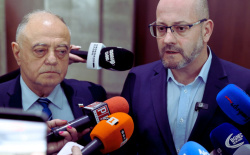
Atanasov (left), Kanev (right)
The political party Democrats for a Strong Bulgaria (DSB) have proposed that Bulgaria consider joining the initiative of French President Emmanuel Macron to extend France’s nuclear deterrence guarantees to other European countries. According to the party’s leader Atanas Atanasov, the issue should be discussed at the highest political level, and he called on President Iliana Yotova to convene the National Security Advisory Council (NSAC) in order to seek a common national position.
Speaking to journalists in parliament, Atanasov said Bulgaria has an interest in participating in the expansion of the French nuclear umbrella, particularly given the rapidly changing security environment in the region. He pointed out that the country is currently facing a period of heightened geopolitical uncertainty because of the ongoing war in Ukraine and the conflict involving Iran. In his view, the question should not be used as part of the election campaign but instead discussed by all political forces with the goal of reaching a national consensus.
Atanasov also proposed the creation of a permanent situational center within the Security Council at the Council of Ministers. According to his idea, such a center would operate around the clock, seven days a week, with security services providing continuous updates on potential risks to national security. The information would then be processed and submitted to the prime minister to support timely and adequate decision-making. Atanasov recalled that a similar mechanism existed during the government of Ivan Kostov at the time of the Yugoslav crisis.
MEP Radan Kanev also commented on the French initiative, noting that President Macron announced last week that several European countries are already holding talks on the extension of French nuclear security guarantees. Kanev pointed out that seven states have so far entered discussions, including Bulgaria’s neighbor Greece. According to him, the proposal remains open to additional EU member states and partner countries that may wish to participate.
From the perspective of DSB, Kanev argued that it would be beneficial for the initiative to extend to the Black Sea region as well. He said that under the current circumstances Bulgaria has a strong national interest in obtaining such security guarantees. Kanev stressed that the topic should be discussed within the National Security Advisory Council with the participation of representatives from all political forces so that a broad consensus can be reached on matters related to national security.
He also suggested that the political formation associated with former president Rumen Radev should be invited to take part in the discussion, given that sociological surveys indicate it will likely enter the next parliament. According to Kanev, issues of national defense should serve as a basis for unity rather than political confrontation during an election period.
DSB representatives rejected suggestions that their proposal could be interpreted as a gesture toward a future political alliance with Radev’s political project. Atanasov emphasized that the goal of the initiative was purely related to security policy.
Asked why the National Security Advisory Council should be convened if the caretaker government has repeatedly stated that there is no direct threat to Bulgaria, Atanasov replied that although there is no immediate danger, risks to national security remain evident. He added that the intention is not to create panic among citizens but to ensure that the state is prepared to react appropriately if circumstances change.
The initiative for a broader European nuclear deterrence framework was first raised by President Macron in March 2025, when he announced plans to begin a strategic dialogue with European allies about extending France’s nuclear umbrella. The idea aims to strengthen European security capabilities and reduce dependence on the United States for nuclear protection.
France has since proposed expanding cooperation through bilateral agreements with participating countries. The concept includes joint exercises in peacetime, the possible establishment of a common headquarters and commitments related to nuclear deterrence in case of war.
Greece has already been identified as one of the countries included in the initial group under the French proposal. According to reports, the initiative currently involves eight European states, most of them from central and northern Europe, regions considered more exposed to potential Russian pressure. Greece is the only country from southern Europe included at this stage, while further negotiations and agreements are expected to develop before the summer.
The project also has the backing of the United Kingdom, Europe’s other nuclear power, and is seen as part of broader efforts to strengthen the continent’s strategic autonomy. The initiative coincides with calls from US President Donald Trump for European countries to assume greater responsibility for their own defense within NATO.
At the same time, the proposal has drawn criticism from Moscow. Russian officials described France’s plan to expand its nuclear deterrence role as a destabilizing step. Russian Foreign Ministry spokeswoman Maria Zakharova argued that the move would significantly increase NATO’s nuclear potential and could pose a threat to Russia in the event of a direct military confrontation.
Kremlin spokesman Dmitry Peskov also commented that any future negotiations concerning the global nuclear balance should take into account the nuclear arsenals of France and the United Kingdom. According to Moscow’s position, these weapons systems should be included in discussions about strategic stability.
Despite such criticism, the French initiative continues to gain attention across Europe as governments examine possible new security arrangements amid the changing geopolitical landscape.
Back