
Bulgaria Breaks Rail Monopoly as First Private Passenger Trains Set to Run After 138 Years
Society | February 11, 2026, Wednesday // 15:57| views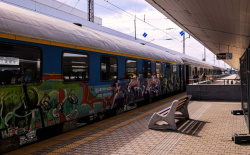
Photo: Stella Ivanova
Bulgaria is set to introduce private passenger rail services for the first time in its 138-year railway history, following the signing of long-term contracts by outgoing Deputy Prime Minister and Minister of Transport and Communications Grozdan Karadjov. The agreements were concluded with the companies that ranked first in the public tender for passenger rail transport.
Under the new structure, the state-owned operator BDZ – Passenger Services will continue to operate the Western region, which accounts for around 75 percent of all passenger rail traffic in the country. The remaining two regions will be served by a private operator for the first time. Ivkoni Express won the tender for the Northern region, representing 14 percent of services, and the Southern region, which accounts for 11 percent.
All three contracts are valid for a 12-year period and are scheduled to take effect on December 13, 2026. Karadjov described the move as historic, noting that Bulgaria will, for the first time, have more than one passenger rail operator and, crucially, a private company entering the sector. According to him, only two additional steps remain to fully implement the railway reforms outlined in the Recovery and Resilience Plan.
The outgoing cabinet had earlier authorized Karadjov to proceed with the signing, stressing that the introduction of a private operator alongside BDZ is a key reform linked to future EU funding. At the same time, the government approved a draft Public Transport Act, which introduces a unified ticketing system covering all modes of transport and allows tickets to be purchased via smartphone.
Karadjov underlined that both decisions are directly tied to the fourth and fifth payments under the Recovery and Resilience Plan, warning that delays or failure to implement them would jeopardize access to European funds.
A central element of the proposed Public Transport Act is the creation of a fully integrated national transport system. This system will synchronize timetables for rail, road, air and water transport, with rail schedules serving as the backbone. Transfers between different modes are expected to be organized with minimal waiting times. The law also establishes a minimum standard of at least three transport connections per day for every settlement.
An electronic platform will be developed at the National Access Point, providing real-time information on routes, schedules and connections. All transport operators will be required to submit up-to-date data, allowing passengers to plan journeys more easily and reliably.
The reform package includes an Intelligent Management System, consisting of a single electronic transport document, a clearing mechanism and a National Transport Model. The unified ticket will allow passengers to purchase a complete journey covering trains, buses, planes or inland water transport in a single transaction. For those who do not use smartphones, a magnetic card with identical functionality will also be available.
According to Karadjov, the clearing system will ensure fair revenue distribution among carriers, while the National Transport Model will enable the state to plan transport policy based on real data, including demand analysis, traffic flows and long-term network development scenarios. For the first time, mandatory quality standards will be introduced, covering punctuality, service frequency, cleanliness, accessibility and timely passenger information, with the user placed at the center of the system.
Ivkoni Express secured its role by winning the two smaller regional lots, giving it responsibility for roughly a quarter of passenger rail services nationwide. BDZ retained the largest and most commercially attractive Western region, which includes key express and fast connections between Sofia and major cities such as Varna, Burgas and Ruse. Only these two companies participated in the tender, with bids opened at the end of November and price offers revealed on December 12.
Karadjov stressed that dividing the services into separate lots was a legal requirement under the Public Service Transport Act. He also warned that missing the December 2026 start date would pose a serious risk to EU financing. The European Commission has already doubled funding for new rolling stock to a total of €734 million, an investment directly linked to the successful completion of the reform.
The minister also addressed concerns about employees, insisting that labor rights are fully safeguarded. No layoffs are planned, and all affected staff will be transferred under the same conditions, with salaries, positions, length of service and social benefits preserved. In practical terms, this applies to 408 employees in the Northern region and 405 in the Southern region, with transfers to be completed before the new contracts come into force.
Back