
MECH and APS Warn of Political Deadlock, Point to Early Elections in Bulgaria
Politics | December 18, 2025, Thursday // 12:22| views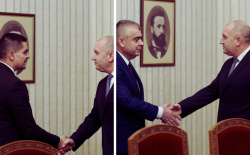
Radostin Vassilev (MECH), President Rumen Radev, Hayri Sadakov (APS)
Radostin Vassilev, leader of the parliamentary group “Morality, Unity, Honor” (MECH), argued during consultations with President Rumen Radev that the government resigned not due to parliamentary opposition, but because of widespread public protests. Speaking in Brussels, he said the cabinet led by Prime Minister Rosen Zhelyazkov was formed through political betrayals, particularly by TISP and BSP, which alienated much of their voter base. Over the past year, Vassilev claimed, the majority failed to make functional decisions, ignored opposition input, and displayed “unprecedented impudence” toward society and institutions.
“The government was not overthrown by the opposition. It was overthrown by the streets,” Vassilev stated, stressing that attempts to form a stable cabinet within the 51st National Assembly were unrealistic. He noted that even with constitutional mechanisms for uninterrupted parliamentary work, the majority continues to disregard democratic principles, and any attempt to form a regular government would require major political betrayals, which parties have refused.
Vassilev added that this parliament is incapable of producing an electoral code that would guarantee fair elections. “We will likely go through a series of elections to cleanse the political landscape of entities that have betrayed public trust. When parliamentary mechanisms fail, change occurs on the streets. Recent events demonstrate that Bulgaria is not far from revolution, with key triggers including Delyan Peevski and Boyko Borissov,” he said.
Earlier consultations with other parties reinforced this view. GERB and WCC-DB announced they would not attempt to form a government. Kostadin Kostadinov of Revival suggested scheduling new elections for the end of March, while Yordan Tsonev from DPS-New Beginning asserted that the parliament had reached the end of its lifecycle. BSP leader Atanas Zafirov confirmed the impossibility of forming a new cabinet, and TISP's Toshko Yordanov warned that reconfiguration efforts were futile.
President Radev also met with representatives of Ahmed Dogan's “Alliance for Rights and Freedoms” (APS). Chairman Hayri Sadakov emphasized that the APS had opposed the first Zhelyazkov cabinet and consistently highlighted the problems with the “Peevski model” of governance. He stressed that while they supported the cabinet initially to ensure progress on priorities like eurozone entry and Schengen accession, public pressure led them to withdraw support. “Given the situation, it is practically impossible to form a cabinet in the 51st parliament,” Sadakov said.
After the meeting, APS described the consultation as constructive. They reiterated the importance of holding elections that are free, fair, and transparent, ensuring every Bulgarian citizen’s vote is properly counted. Regarding the timing of elections, Sadakov noted that this remains under presidential consideration, with consultations ongoing with all parliamentary groups.
The resignation of Zhelyazkov’s government followed months of large-scale protests across Bulgaria, signaling deep public dissatisfaction with the political system. Vassilev and APS representatives alike underscored that the current parliamentary majority is incapable of implementing effective governance, leaving early elections as the most viable path forward.
Back