
Trump’s Easter Message Citing “Allah” and Threatening Iran Stuns US Politicians
World | April 6, 2026, Monday // 09:15| views
Sharp reactions have emerged across the US political spectrum after President Donald Trump issued an unusually aggressive and profanity-filled message directed at Iran, intensifying tensions amid the ongoing war. In a post published on his Truth Social platform, Trump demanded that Tehran reopen the Strait of Hormuz, using explicit language and warning that failure to comply would lead to devastating strikes on the country’s energy and transport infrastructure. He also signaled that Tuesday would mark a potential escalation, referring to planned attacks on key facilities.
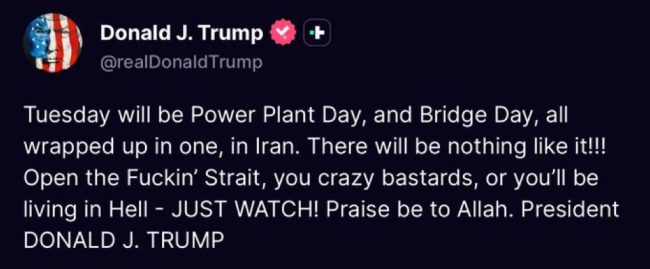
The statement came as Washington approaches another self-imposed deadline for Iran to unblock the strategic waterway, which has remained effectively closed since the outbreak of hostilities at the end of February. The Strait of Hormuz is a critical route for global oil and gas shipments, and its disruption has already driven energy prices to record levels. Trump has repeatedly issued ultimatums in an attempt to force Tehran to act, while also expressing frustration toward European and NATO allies who have declined to support the US-Israeli campaign or intervene in the crisis.
Tehran responded by reiterating that the strait would only be reopened under specific conditions, including compensation for war-related damages through a newly structured system of transit fees. Iranian officials also dismissed Trump’s rhetoric, describing it as a reflection of mounting pressure and frustration rather than a coherent strategy.
In the United States, the president’s remarks triggered a wave of criticism, particularly from Democratic lawmakers. Senate Minority Leader Chuck Schumer described the outburst as the behavior of “an unhinged madman,” warning that such language risks alienating allies and raising the prospect of actions that could violate international norms. Senator Bernie Sanders similarly condemned the tone, calling it dangerous and questioning Trump’s judgment, while urging Congress to intervene and bring an end to the conflict.
Other Democratic figures echoed these concerns. Senator Chris Murphy characterized the comments as entirely unbalanced and suggested that senior officials should be considering constitutional mechanisms to address the situation. Senator Tim Kaine criticized the broader approach of the administration, arguing that the rhetoric reflects a lack of clear planning and strategic direction, while also warning that threats against civilian infrastructure could have serious humanitarian consequences.
Criticism also came from within Republican circles. Former ally Marjorie Taylor Greene openly rebuked the president, describing his behavior as unacceptable and calling on members of his administration to intervene. She argued that the war contradicts previous commitments to avoid foreign conflicts and warned that attacks on infrastructure would primarily harm civilians rather than achieve strategic objectives.
At the same time, not all responses were negative. Some conservative commentators voiced strong support for Trump’s hardline stance, praising both the message and the threat of further military action against Iran. The divide in reactions highlights the deepening political polarization in Washington over the conduct of the war and the president’s approach.
The controversy was further amplified by the timing of the remarks, which were made on Easter Sunday, drawing additional criticism over tone and appropriateness. As the deadline approaches and tensions remain high, the episode underscores the volatile mix of military pressure, diplomatic deadlock and domestic political confrontation shaping the next phase of the conflict.
Back