
The Bet That Didn't Pay Off: How the US Miscalculated Its War Against Iran
World |Author: Nikola Danailov | March 30, 2026, Monday // 12:38| views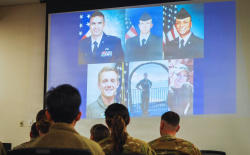
U.S. Air Force Airmen attended a vigil organized by the 909th Air Refueling Squadron at Kadena Air Base in Japan on March 20, 2026, honoring six Airmen who died in a KC-135 Stratotanker crash while supporting Operation Epic Fury @Wikimedia Commons
Thirty-one days into Operation Epic Fury, the Islamic Republic is still standing. That single fact is the most damning verdict on how this war was conceived.
The original logic rested on the idea that a sharp enough military strike would do two things at once: decimate Iran's military infrastructure and trigger a popular uprising that would finish the regime from the inside. Trump called on Iranians to seize a "once-in-a-generation opportunity" to take control of their country from the opening hours of the campaign, suggesting the ultimate objective was regime change. The bombs were meant to be the signal. The Iranian street was supposed to do the rest.
It hasn't worked out that way.
The protests that shook Iran in January were real and significant. They became the most serious challenge to the Islamic Republic since the Woman, Life, Freedom movement in 2022 and 2023, spreading to all 31 provinces and drawing millions into the streets. The regime's response was equally real and far more decisive. The government launched a brutal crackdown on January 8, and according to officials in Iran's Ministry of Health, at least 30,000 people were killed in just the first 48 hours. By late January, the protests had been suppressed. Iran imposed the longest internet blackout on record to restrict reporting on the unrest and disrupt communication among demonstrators.
What Israel and the US appear to have misread is what that crackdown actually meant. Rather than reading it as a sign that the regime was desperate and therefore fragile, they seem to have drawn the opposite conclusion: that a weakened but surviving regime, having just massacred tens of thousands of its own citizens, would crack under the additional pressure of airstrikes. Iran's own information warfare during the protests shifted from partial acknowledgment of grievances to a full narrative of foreign interference, framing demonstrators as agents of Washington and Tel Aviv. By the time the bombs fell on February 28, the regime had already consolidated its internal narrative around an external enemy. The war gave that narrative oxygen.
The intelligence dimension of this failure is uncomfortable to examine but impossible to avoid. Tensions have since emerged between Netanyahu and Mossad chief David Barnea regarding the failure of plans to collapse the Iranian regime, and the New York Times reported that in January, Barnea presented US officials with a plan to induce a successful insurrection after regime decapitation was carried out. That plan did not materialize. As of the third week of the war, analysts found little evidence of significant defections or desertions in the Iranian military, which had been considered a necessary condition for regime change.
On the American side, the picture is no cleaner. Pentagon briefers reportedly told Congress that the US did not have intelligence that Iran was planning a preemptive strike against the US, which was one of Trump's stated justifications for launching the campaign. NBC News reported that Trump has been receiving his daily war briefing in the form of a highlight reel of successful strikes compiled by military officials, running for about two minutes, with real questions now emerging about the ability of the US intelligence apparatus to provide accurate information to the commander-in-chief. A president receiving a curated montage of bomb damage assessments is not a president being told what is actually happening on the ground.
Trump was poorly advised by a coterie of advisers unwilling to say anything other than yes, with the possible exception of JD Vance, who has backed Trump publicly but expressed reservations in the past. Netanyahu may have determined the timing of the conflict, but Trump was likely already on his way to war, caught up in a self-generated aura of military invincibility after the Venezuela operation. The idea that Netanyahu manufactured this war and dragged an unwilling Trump into it is too simple. The more accurate picture is of two leaders who each had their own reasons to want this fight and whose confidence reinforced each other at precisely the moment when more sober counsel was needed.
Iran, for its part, knew exactly where it stood. Security forces had expanded their presence in major cities well before the strikes, and the regime spent weeks framing the protests as foreign-influenced attempts to destabilize the country. The regime was not surprised by the attack. It had spent years preparing for this scenario and had already done the domestic work of crushing meaningful internal dissent before the first missile landed. Iranian officials have since made clear their strategy: cause enough pain to the world economy that any nation thinking of attacking Iran again will do so knowing these are the consequences.
The strategic picture now is one of tactical success and strategic stalemate. The US and Israel have destroyed significant military infrastructure, but as one analyst noted, what comes next, the successor to Khamenei, the reconstituted IRGC, the popular rage now fused with nationalist fury, is a harder problem than the one anyone imagined they were solving. The risk for Washington is that it can degrade Iranian capabilities without fully securing the Strait of Hormuz, winding up in a protracted, costly conflict with uncertain political payoff. Brent crude is trading up more than 50 percent since the war began, and according to the IEA, the closure of the Strait represents the biggest oil shock in history.
There is a structural problem underneath all of this that makes resolution harder to reach: both sides currently believe they are winning, or at least that continuing the fight is preferable to conceding. Iran thinks the energy shock will eventually break Western resolve. Washington thinks more strikes will eventually break the regime. Each side's assessment of its own strength widens the gap between their negotiating positions. Wars that begin with this kind of mismatch, where each party enters the conflict with fundamentally different expectations about their own leverage and the other side's breaking point, tend to drag on until reality forcibly corrects at least one side's assumptions.
There is a more optimistic reading. If US intelligence eventually concludes, as it may be approaching, that the protests are not coming back in any meaningful form and that the regime will not fall from the inside, then American expectations will start converging toward Iranian ones. At that point, the conditions for a genuine negotiated exit begin to exist. Pakistan has already offered to host meaningful talks, and there are signs that messages are moving through back channels.
Getting there requires someone to admit that the original bet did not pay off. German Chancellor Merz has already said publicly that the US and Israel are becoming increasingly entangled in the conflict and lack a clear strategy. That is a polite way of saying what the thirty-first day of this war has made difficult to argue against: the opening assumptions were wrong, the protests did not materialize into a revolution, and the war sold as a catalyst for regime change has instead given the Iranian government its most effective rallying point in decades.
Back